
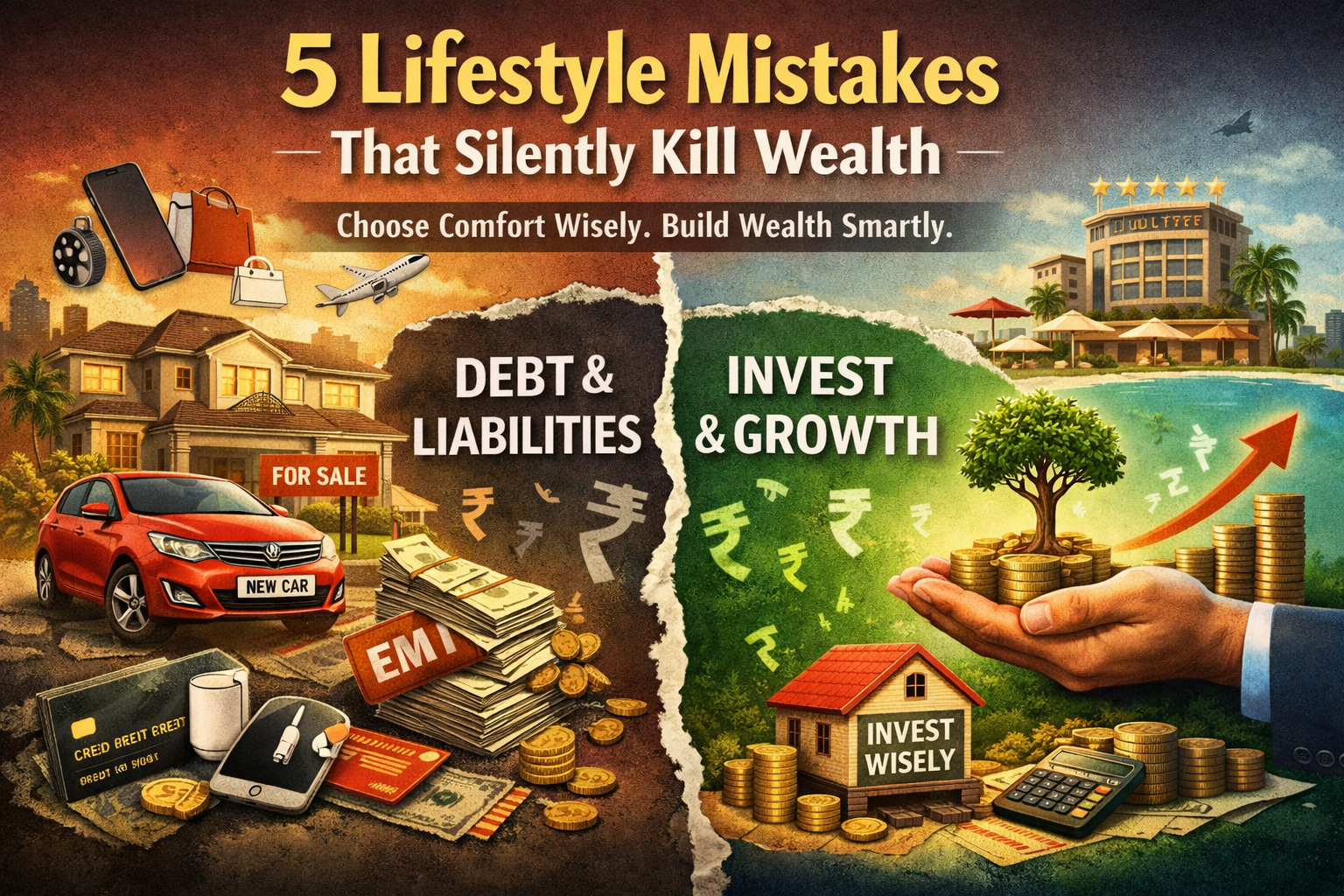
A Critical Perspective Before We Begin
Cars, houses, furniture, gadgets, and vacations are tools of comfort — not indicators of wealth.
A car is a tool to move from Point A to Point B
A house is a tool that provides shelter and safety
Furniture & interiors are tools for comfort
Technology is a tool for productivity
Vacations are tools for rest and mental refresh
When we forget their purpose, these tools silently turn into financial liabilities.
Every rupee saved by making rational choices here becomes investible capital. That same money, when invested wisely, compounds into a large asset over time — without any interest cost, unlike EMIs and loans.
1. Purchasing Brand-New Cars for Status
A car’s job is simple:
To take you safely from Point A to Point B.
The difference is not in comfort — it is in financial impact.
Example: New Car vs Second-Hand Car
Option A: Brand-New Car
Cost: ₹10,00,000
Loan tenure: 5 years
Interest rate: 9% p.a.
Monthly EMI: ₹20,758
Option B: Second-Hand Car
Cost: ₹5,00,000
Loan tenure: 5 years
Interest rate: 9% p.a.
Monthly EMI: ₹10,379
👉 Monthly EMI saved: ₹10,379
Now comes the real wealth decision.
If the Saved EMI Is Invested
Monthly SIP: ₹10,379(For the 1st five Years only)
Expected return: 15% p.a.
Investment period: 10 years
👉 Future value of investment:₹18.25+ lakhs (approx.)
After 10 years:
The car has depreciated
The comfort served its purpose
But the invested EMI has become a sizable asset
Same mobility. Completely different wealth outcome.
2. Buying Houses Beyond True Affordability
A house is meant to:
Provide stability
Offer peace of mind
Create security
When EMIs consume a large portion of income, the house stops being a comfort tool and becomes a financial burden.
Example: Overstretching vs Affordable Home
Option A: Overstretching the Purchase
House cost: ₹50 lakhs
Loan tenure: 20 years
Interest rate: 9% p.a.
Monthly EMI: ₹44,986
Option B: Affordable & Balanced Choice
House cost: ₹35 lakhs
Loan tenure: 20 years
Interest rate: 9% p.a.
Monthly EMI: ₹31,490
👉 Monthly EMI saved: ₹13,496
If the EMI Difference Is Invested
Monthly investment: ₹13,496
Expected return: 15% p.a.
Investment period: 20 years
👉 Future value of investment:₹1.79 crore (approx.)
3. Treating Furniture & Interiors as Assets
Furniture and interiors:
Add comfort
Improve aesthetics
But they:
Do not appreciate
Lose value over time
Have limited resale worth
Frequent upgrades drain savings
Many people repeatedly spend on:
Modular kitchens
Premium sofas
Designer interiors
Comfort should be functional. Excess should be invested.
4. Using Technology as a Status Symbol
Technology is meant to:
Improve productivity
Enable communication
Save time
Frequent upgrades driven by trends convert useful tools into financial drains.
The same money, if invested instead of upgraded, can compound silently into a meaningful corpus.
Let your money upgrade your future before upgrading your gadgets.
Vacations are tools for:
Mental refresh
Family bonding
Luxury experiences funded through EMIs or credit cards create:
Interest costs
Reduced investments
Post-vacation financial stress
Memories should not come with long-term repayment schedules.
A Powerful Question That Changes Every Financial Decision
Instead of asking:
“Can I afford this?”
Ask:
“How much of my future money am I committing by owning this?”
Affordability looks at today’s income.
Commitment looks at tomorrow’s cash flows.
This single shift in thinking leads to far more rational financial choices.
The Real Lesson
Smart lifestyle decisions do two things simultaneously:
Reduce interest-bearing liabilities
Create surplus for compounding investments
Over time, this gap between assets and liabilities decides who becomes wealthy and who remains financially stressed.
Final Thought
True wealth is not about denying comfort.
It is about deploying money where it grows instead of where it depreciates.
At PVR Advisory, we believe:
“Assets grow through compounding.
Liabilities grow through interest.
Wise choices decide which one dominates your life.”
Wealth is built quietly — one rational decision at a time.
Note: I written this article with an inspiration of this ideology from Charlie Munger & Warren Buffet.
Disclosure: Investments in securities market are subject to market risks. Read all the related documents carefully before investing. Registration granted by SEBI, membership of BSE and certification from NISM in no way guarantee performance of the intermediary or provide any assurance of returns to investors



